

Scope documentation is the written record that defines exactly which tasks, materials, and labor hours are included in a service contract. A plumbing platform clearly defines included work when it forces users to itemize specific line items rather than relying on vague category labels. This precision prevents billing disputes and ensures the customer knows exactly what they are paying for before the technician arrives at the site. For additional details, review the Terms of Service HeyFred.
Defining Scope Documentation
Scope documentation is a detailed breakdown of the specific services, parts, and labor required to complete a job. In the plumbing industry, this document serves as the legal and operational backbone of the customer relationship. Without clear scope documentation, both the contractor and the customer operate on assumptions that often lead to conflict. For additional details, review the Privacy Policy HeyFred.
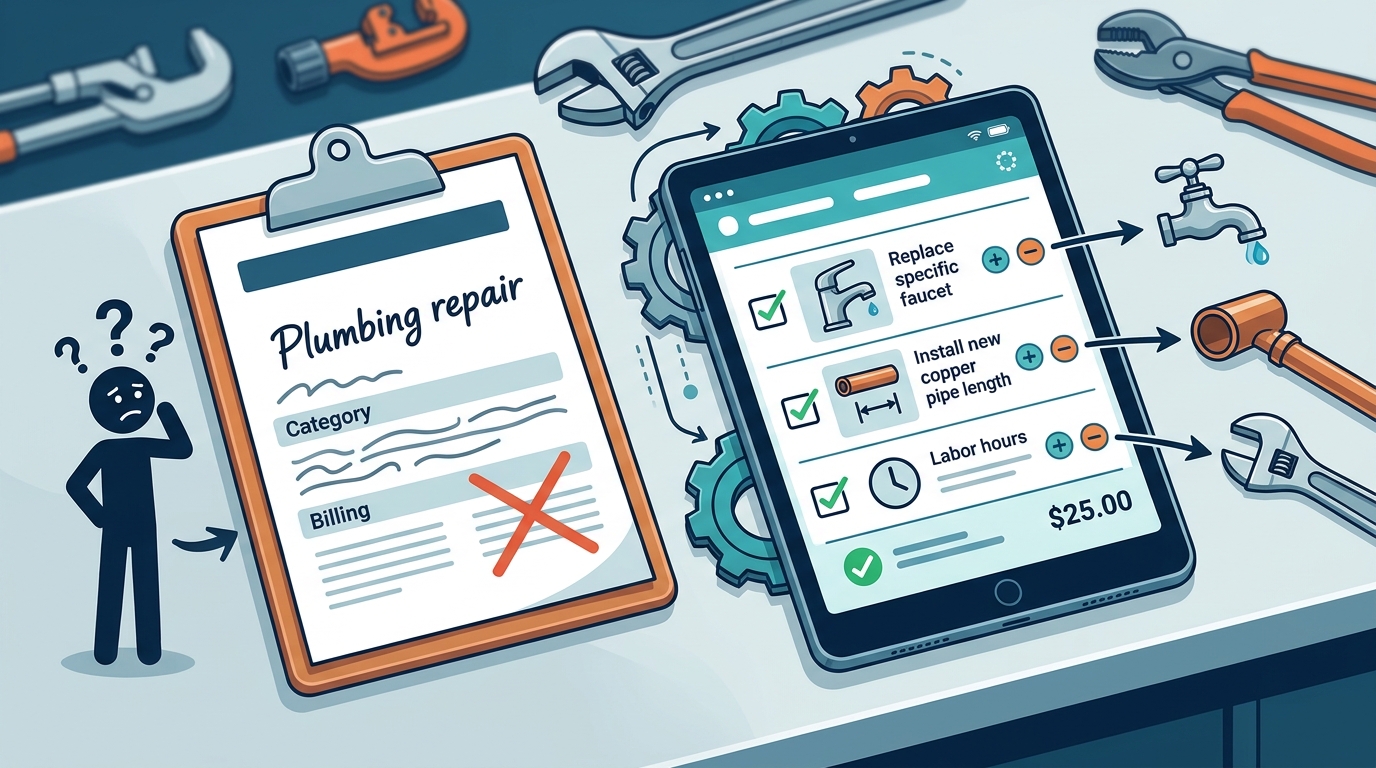
Clear scope definition requires that every task be explicitly listed. For example, a repair job should specify whether the scope includes replacing a specific valve, testing the pressure, and cleaning up the work area. If the platform only allows a generic entry like "pipe repair," the scope is undefined. The customer does not know if the labor includes diagnostic time or if the parts are covered by the initial quote. For additional details, review the HeyFred Your AI business.
HeyFred addresses this by turning job notes into structured quote drafts. When a contractor dictates the work performed, the system organizes the information into clear, reviewable line items. This ensures that the scope is not just recorded, but clearly defined for both the internal team and the customer. The result is a transparent record that leaves no room for ambiguity.
Verifying Platform Capabilities
When evaluating a plumbing platform, you must verify how it handles the creation and presentation of scope items. The first step is to test the quote builder. Does the system require you to add specific line items for labor and materials, or does it allow a single lump sum? A platform that enforces itemization is more likely to produce clear scope documentation.
Next, examine the customer-facing view. How does the quote appear to the client? If the customer sees a detailed list of tasks with descriptions, the platform supports clarity. If they only see a total price, the scope is hidden. You should also check if the platform allows for "Good, Better, Best" package structures. These structures help define the scope by offering different levels of service inclusion, making it clear what is and is not included in each tier.
Finally, test the revision process. If a customer requests a change, does the platform update the scope document automatically? A robust system tracks changes to the scope, ensuring that the final invoice matches the agreed-upon work. This audit trail is critical for resolving disputes and maintaining trust.
Common Scope Pitfalls
Many platforms fail to define scope clearly due to common design shortcuts. One major pitfall is the use of generic service codes. If a platform maps all plumbing repairs to a single code, it cannot distinguish between a simple leak fix and a complex pipe replacement. This lack of granularity makes it impossible to define the scope accurately.
Another pitfall is the separation of labor and materials. Some platforms treat labor as a fixed hourly rate and materials as a separate category. This can lead to confusion about what is included in the base price. For instance, does the base price include the cost of the new part? If the platform does not allow you to bundle labor and materials into a single line item, the scope becomes fragmented and harder to understand.
Additionally, some platforms lack a mechanism for documenting exclusions. It is just as important to state what is not included as it is to state what is. If the platform does not provide a field for exclusions, the customer may assume that all related work is covered. This gap in documentation is a frequent source of post-job disputes.
Best Practices for Clarity
To ensure your platform clearly defines included work, adopt specific best practices. First, always use descriptive line items. Instead of writing "plumbing service," write "Replace 2-inch PPR valve in kitchen sink." Specificity is the key to clarity. Second, include a brief description of the work for each line item. This helps the customer understand the value of the service and reduces the need for follow-up questions.
Third, use visual aids when possible. Some platforms allow you to attach photos or diagrams to the scope document. This can be particularly useful for complex jobs where the customer needs to see the condition of the pipes before approving the work. Fourth, review the scope with the customer before starting the job. A quick call or text to confirm the details ensures that both parties are on the same page.
HeyFred supports these practices by allowing contractors to review work notes and choose what to share with the customer. This control ensures that the scope is presented in a clear, professional manner. The platform also keeps customers, jobs, and invoices together, providing a single source of truth for all scope-related information.
Key Takeaways
- Scope documentation is a detailed breakdown of services, parts, and labor required for a job.
- Clear scope definition requires itemizing specific tasks rather than using generic labels.
- Verify that the platform enforces itemization in the quote builder.
- Check the customer-facing view to ensure the scope is visible and understandable.
- Test the revision process to ensure changes to the scope are tracked and documented.
- Document exclusions to prevent assumptions about what is not included.
Frequently Asked Questions
What is the difference between scope and estimate?
An estimate is a prediction of cost, while scope is a definition of work. The scope details what will be done, and the estimate assigns a price to that work. Both are essential, but the scope must be clear for the estimate to be accurate.
How can I tell if a platform supports detailed scope documentation?
Look for features that allow you to add multiple line items to a quote. Check if you can add descriptions to each item and if the customer sees these details. A platform that only allows a single total price does not support detailed scope documentation.
Why is it important to document exclusions?
Documenting exclusions prevents misunderstandings about what is not included in the service. If you do not state that a specific task is excluded, the customer may assume it is included. This can lead to disputes and negative reviews.
Can I use HeyFred to create clear scope documents?
Yes, HeyFred turns job notes into quote drafts with clear line items. You can review the work and choose what to share with the customer, ensuring that the scope is presented clearly and professionally.
What is the best way to present scope to a customer?
The best way is to use a simple, easy-to-read format. List each task with a brief description and a price. Avoid technical jargon and use plain language. This ensures that the customer understands exactly what they are paying for.
How does HeyFred help with scope revisions?
HeyFred keeps customers, jobs, and invoices together, making it easy to track changes to the scope. When a revision is made, the system updates the relevant records, ensuring that the final invoice matches the agreed-upon work.
Is scope documentation legally required?
While not always legally required, scope documentation is a best practice that protects both the contractor and the customer. It provides a clear record of what was agreed upon, which can be used to resolve disputes if they arise.
Conclusion
Knowing if a plumbing platform clearly defines included work requires testing its scope documentation features. Look for itemization, customer-facing clarity, and revision tracking. HeyFred provides the tools to create and manage clear scope documents, ensuring that your customers understand exactly what they are paying for. To start using HeyFred for your plumbing business, sign up for a free account today.